The patio price is the part people want first. That is a fair question. You need to know whether this is a small job you can pay for now, or a project to put off until next year. In Connecticut, the surface you choose changes the bill quite a bit. So does the yard, even before any stone goes down.
How Much Does a Patio Cost in Connecticut?
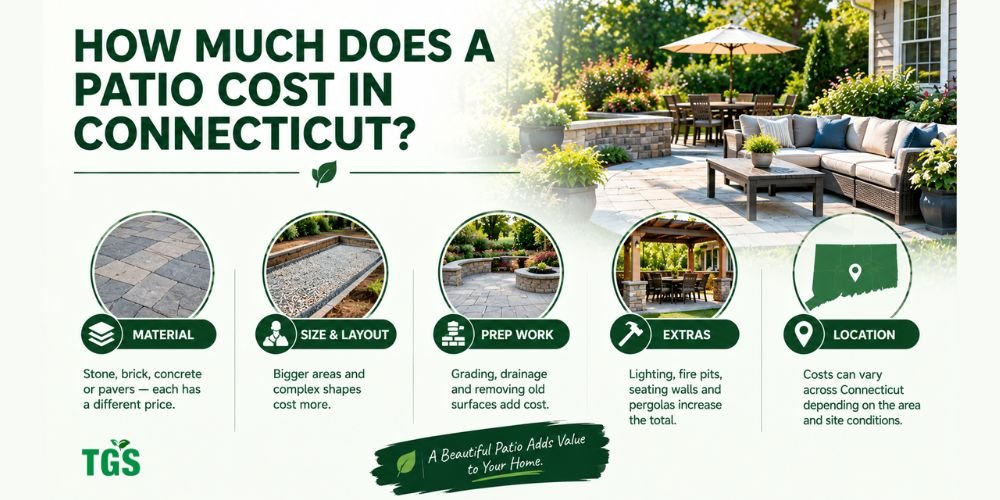
For a rough budget, put patio cost in Connecticut at $15 to $60 or more per square foot installed. That’s a broad estimate for your 2026 plans, not a price for a specific yard. Plain concrete can start lower. The concrete paver estimate is $20 to $45 per square foot.
Say you want 20 feet by 20 feet. That’s 400 square feet, which puts pavers at about $8,000 to $18,000. Quite a gap, yes. But a contractor cannot narrow it much without a look at the property. An old slab underfoot or a slope at the far end can change the job.
Patio Prices by Material
Plain concrete costs less than most of the other choices here. You get a slab, with no separate pieces to replace if it cracks. Pavers cost more at first, but a damaged piece can come out on its own. That difference may matter to you a few years from now.
Then there’s stone. If you like bluestone, get a price for it before you rule it out. Perhaps a smaller stone patio would suit you better than a larger surface you don’t particularly want. There’s no rule that you have to pave all the space beside the house.
| Material | Estimated installed cost per sq. ft. (USD) | Appearance and durability | Care and use |
| Poured concrete | 12–25 | Plain slab. Ground movement can cause cracks. | Low routine care. Patch repairs may show. Suits a basic patio. |
| Stamped concrete | 18–35 | Patterns resemble stone. The slab can still crack. | Needs periodic seal coats. Repairs may disrupt the pattern. |
| Concrete pavers | 20–45 | Choice of colors and shapes. Needs firm base support. | Replace separate pieces. Suits a table or lounge area. |
| Bluestone | 25–55 | Natural blue-gray stone. Thickness and finish vary. | Care depends on finish. Crews can replace separate stones. |
| Flagstone | 20–45 | Irregular shapes give a less uniform look. | Joints need care. Suits a patio with natural borders. |
| Granite or natural stone | 30–60+ | Look and durability depend on the stone type. | Heavy pieces cost more to replace. Suits custom stone patios. |
| Permeable pavers | 25–50+ | Open joints let water enter a purpose-built base. | Keep joints clear. Suits sites with a suitable runoff plan |
How Much Does a Patio Cost Based on Size?
Ten feet each way gives you 100 square feet. Twenty feet each way gives you 400. The jump is easy to miss on a small sketch, but you will see it in the amount of stone on the quote. You need base material under all of it too. So, before you add a few feet at the edge, have the total worked out again.
Here are four examples at $20 to $45 per square foot for pavers. Take them as sums for a budget. A contractor may have a minimum charge on a small job, so your 100-square-foot quote won’t necessarily come in at the bottom number.
| Patio size | Square footage | Estimated paver cost (USD) | Possible use |
| 10 × 10 ft | 100 sq. ft. | 2,000–4,500 | Bistro table for two |
| 12 × 16 ft | 192 sq. ft. | 3,840–8,640 | Family meals |
| 16 × 20 ft | 320 sq. ft. | 6,400–14,400 | Lounge or grill area |
| 20 × 20 ft | 400 sq. ft. | 8,000–18,000 | Large table or fire pit |
What Does Professional Patio Installation Include?
A professional patio installation should cover more than laying pavers. Before work begins, confirm these details in your quote:
- Old patio removal: Who removes the existing patio and pays disposal fees?
- Excavation and base: How deep will the crew dig, and how thick will the compacted crushed-stone base be?
- Ground preparation: Will soft or unstable soil be addressed before the base goes in?
- Paver installation: Does the price include the bedding layer and edge restraints?
- Drainage and cleanup: Where will rainwater flow, and who removes construction waste?
Get each item confirmed in writing before paying a deposit. This helps prevent unexpected costs and disagreements later.
What Can Increase Patio Installation Costs?
Patio costs depend on more than the pavers you choose. Common factors include:
- Difficult access: Narrow gates or limited space may require extra labor or smaller equipment.
- Old patio removal: Removing and disposing of concrete or existing materials adds costs.
- Ground conditions: Slopes, soft soil, extra excavation, or retaining walls can increase the price.
- Design features: Curved edges, steps, and fire pits require additional materials and labor.
To keep costs manageable, consider a simpler design, straight edges, or a smaller patio. Ask for separate pricing for optional features before work begins.
Why Patio Base Preparation Matters in Connecticut
Connecticut’s freeze-thaw cycles can shift patio stones and cause uneven surfaces. A properly prepared, compacted base helps reduce this risk. The right base depth depends on your soil, patio material, and site conditions. Ask your contractor to explain the planned depth and preparation. Drainage matters, too. Tell your contractor where water collects after rain so the patio directs runoff away from your home.

Do You Need a Permit for a Patio in Connecticut?
Permit requirements vary by town. Setbacks, lot coverage, retaining walls, grading, drainage, and wetlands may affect your project. Before construction, contact your town’s building or zoning office to confirm local requirements. In Trumbull, review your patio plans with the appropriate town office before excavation begins. Also, confirm in writing whether you or your contractor will handle any required permits.
What Patio Size Should You Choose?
Choose a patio size based on your furniture, seating, and how you plan to use the space.
- 10 × 10 feet: A small seating area for two.
- 12 × 16 feet: More room for family meals.
- 16 × 20 feet: Space to consider separate dining and lounging areas.
Before finalizing the size, mark the layout with a garden hose and test it with your actual furniture. Leave enough room to walk comfortably, access the yard, and meet the manufacturer’s clearance requirements if adding a grill.
What Should You Check Before Hiring a Patio Contractor?
Compare quotes for the same patio size, pavers, and materials. Make sure each quote includes:
- Base preparation: Excavation depth, compacted stone base, and edge restraints.
- Removal and drainage: Old patio disposal, water management, and any required drains.
- Permits and lawn repairs: Who handles permits and repairs damage caused by equipment?
- Payment and warranty: Deposit terms, warranty coverage, and payment schedule.
- Extra costs and timeline: How unexpected soil problems will be priced, plus expected start and completion dates.
Get everything in writing, including how the contractor will communicate weather-related delays. This makes quotes easier to compare and helps prevent surprise costs.
Is a Patio Worth the Investment?
A patio can make your yard more comfortable and useful, providing a stable place for outdoor dining, relaxing, or entertaining. Choose a size that fits your needs and budget. A small seating area may be enough, especially near the kitchen or back door. Consider long-term maintenance costs, too. Treat increased resale value as a potential benefit, not a guarantee. The best patio is one you can afford and enjoy using.
When Should You Hire a Professional for Patio Installation?
A steep yard deserves a look from a contractor before you start any soil work. Water near the foundation is another reason to get help. On a patio with several levels, the support needs its own plan; the surface price on its own won’t tell you what the project costs.
Our patio and hardscape services cover Trumbull, CT, and nearby areas. If you have a rough idea rather than a finished plan, that is fine. We can assess the yard and discuss the area you want to use before you choose a design.
Conclusion
Work out how much space you need before you settle on a material. Then compare the site work in your quotes, since patio cost in Connecticut depends on the yard as well as the surface. If a price comes in lower, check what it covers before you decide it is the better deal.
You can request a quote from TG’s Landscaping once you have a size in mind. Or tell us if you’re unsure how much space you need yet. We’ll discuss your plans for the yard and help you decide what to price.
FAQs
- How much should I budget for a patio in Connecticut in 2026?
Roughly $15 to $60 or more per square foot is the estimate to start with here. Plain concrete may fall below it. Your yard needs a quote of its own before you set the final budget. - What is the price of a 20 × 20-foot patio in CT?
For pavers at the rates here, allow $8,000 to $18,000. That’s 400 square feet. Extra site work can take the quote past either end of the range. - How much do patio pavers cost per square foot?
About $20 to $45 per square foot is the paver estimate used here. You still need to check the scope behind that number. It may not include an old slab that has to come out first. - Is a concrete patio cheaper than pavers?
Usually, for plain concrete. Pavers have a different benefit: one damaged piece can come out without a patch across the whole surface. - What does a bluestone patio cost?
For a budget, I’d use $25 to $55 per square foot from the table. Then get a quote that names the actual stone, with its thickness. ‘Bluestone’ on its own doesn’t explain the full price. - Which patio material costs the least?
Plain concrete has the lowest estimated rate in our table. Gravel may be less expensive, though it isn’t the same sort of firm surface for furniture. - Does patio installation include excavation?
For a new patio, it should be part of the scope. Have it on paper with the base work, rather than assume it’s in the total. - Why are some patio quotes much higher?
A small access gate may cost you more labor than an open yard would. Poor soil can add work too. If the site work looks the same, compare the stone grade and any extras in the price. - Are permits necessary for backyard patios?
That is a question for your town. Tell staff where the patio will go and how large it will be. If you plan a wall as part of it, mention that on the call too. - Can you put a patio on a sloped yard?
Yes, though it isn’t the same job as a flat yard. Have the contractor assess the slope first. The plan may need extra excavation, or it may need a wall to support the new level. - Why does a patio need drainage?
Water has to get off the patio without a route back to your house. The water below it matters too, since a freeze can cause ground movement. That’s why the surface grade alone isn’t the whole water plan. - How many days does patio installation take?
A small job may be two to four days. A larger patio may be a week or more. Don’t book your plans around those figures yet; get dates from the contractor for your own site, with some room for weather delays.